

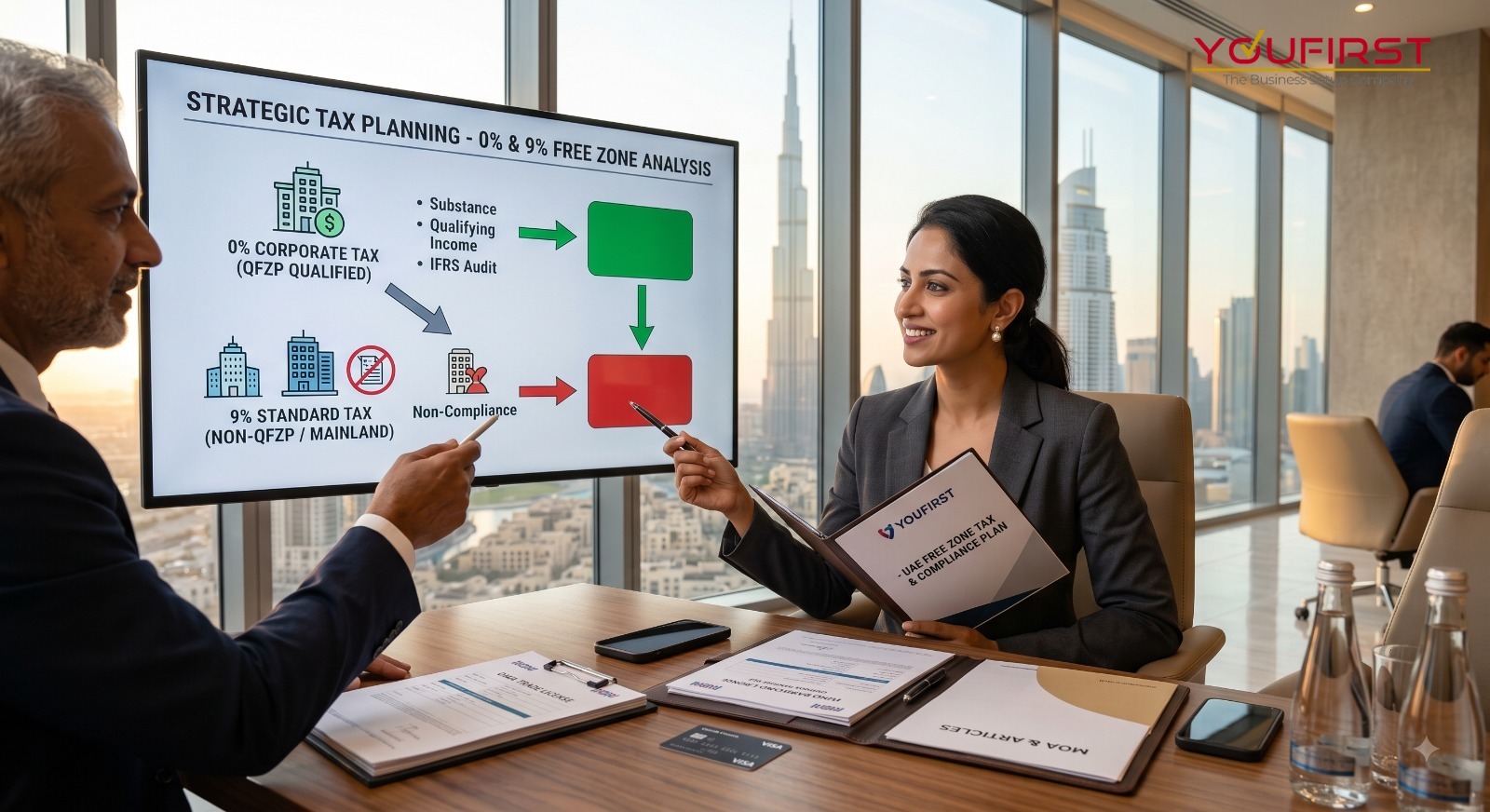
Dubai Free Zone Business Setup: New Rules for Tax and Trade License Renewal
Selecting a Dubai free zone business setup has long been the preferred route for international founders seeking 100% foreign ownership, zero import duties, and complete capital repatriation.
However, recent enforcement updates from the Federal Tax Authority (FTA) and free zone registries have changed day-to-day operations. Free zone entities are no longer automatically tax-exempt by default. To retain the headline 0% corporate tax rate and keep bank accounts active, business owners must satisfy specific legal substance requirements and complete their annual trade license renewal in Dubai on time.
This guide details the current corporate tax requirements for free zone businesses, how qualifying income is determined, and how to manage yearly license renewals without penalties or operational freezes.
Quick Summary: Free Zone Tax and Renewal Compliance
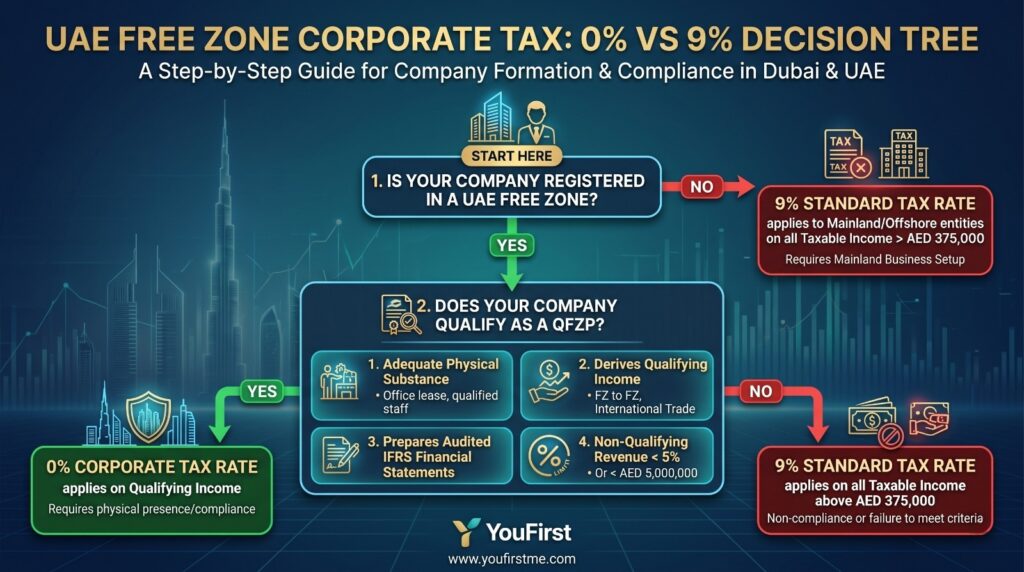
Direct Answer for Business Owners: A free zone company in the UAE qualifies for a 0% corporate tax rate only if it meets the criteria of a Qualifying Free Zone Person (QFZP). This requires conducting qualifying commercial activities, maintaining physical economic substance (an office lease and resident staff), and staying within the de minimis threshold for non-qualifying income (under 5% of total revenue or AED 5,000,000). Failing these rules or delaying trade license renewal results in an automatic 9% tax rate, monthly late fines, and frozen corporate bank accounts.
Corporate Tax for Free Zones: 0% vs 9%
Under UAE Federal Decree-Law No. 47 on Corporate Taxation, all free zone entities are legally classified as taxable persons. The difference lies in whether your revenue qualifies for the 0% benefit or the standard 9% rate.
1. Qualifying Income (0% Tax Rate)
Free zone companies pay 0% corporate tax on income generated from transactions with other free zone businesses or foreign entities. This includes manufacturing, processing goods, logistics, fund management, and headquarters services.
2. Non-Qualifying Income and the De Minimis Rule
If a free zone entity sells directly to individuals or conducts commercial business with the UAE mainland without a mainland branch, that revenue is classified as non-qualifying. If non-qualifying income exceeds 5% of total annual revenue or AED 5,000,000 (whichever is lower), the business loses its qualifying status and the entire revenue is taxed at 9% for five consecutive years.
3. Audited Financial Statements Requirement
Every business claiming the 0% rate must prepare and maintain audited financial statements prepared under International Financial Reporting Standards (IFRS). Skipping this audit forfeits the tax exemption immediately.
Free Zone vs. Mainland: Tax and Renewal Requirements
| Regulatory Area | Dubai Free Zone Setup | Mainland Business Setup |
|---|---|---|
| Headline Tax Rate | 0% (if QFZP criteria met) or 9% | 9% on taxable profits above AED 375,000 |
| Licensing Authority | Specific Free Zone (e.g., DMCC, SAIF, DSO) | Department of Economy and Tourism (DET) |
| Mandatory Office Type | Flexi desk, smart desk, or physical office | Ejari-registered physical office or commercial space |
| Mainland UAE Retail Trade | Requires a distributor or mainland branch | Direct, unrestricted local commercial activity |
| Annual Audit Mandate | Required for all QFZP tax-exempt entities | Required for entities exceeding AED 50,000,000 revenue cap |
| Typical Renewal Cost Range | AED 8,000 to AED 22,000+ | AED 12,000 to AED 18,000+ (plus Ejari lease) |
Trade License Renewal: Rules, Timelines, and Fines
An expired trade license leads to immediate operational problems. Operating a company with an expired license triggers automated penalties and bank restrictions across the UAE.
- Grace Period: Free zones and the mainland typically provide a 30-day grace period following license expiration to submit renewal paperwork without financial penalties.
- Late Renewal Fines: If a license is not renewed after the 30-day window, recurring monthly fines of AED 250 accrue on the account.
- Unauthorized Operations Penalty: Conducting business activities or issuing invoices while the license is expired carries administrative fines of AED 5,000.
- Bank Account Suspension: UAE banks run automated checks against commercial registries. If a renewed trade license is not submitted within 30 to 60 days of expiry, outward transfers are suspended, and merchant payment gateways are frozen.
- Visa Processing Lock: Sponsoring new employee visas, renewing existing residency permits, or obtaining labor cards is completely blocked until the license renewal is finalized.
Step-by-Step Trade License Renewal Checklist
To maintain uninterrupted operations for your trading license in the UAE, execute this renewal sequence 30 to 45 days before the printed expiry date.
1. Renew the Commercial Lease
Secure your tenancy contract (Ejari for mainland or free zone lease agreement). Licensing authorities will not process a license renewal without proof of valid registered office premises.
2. Gather Shareholder and Director Clearances
Collect valid passport copies, Emirates IDs, and residential address verifications for all active shareholders and appointed managers.
3. Complete Annual Financial Statements
If your business is registered for corporate tax or VAT with the Federal Tax Authority, complete your yearly bookkeeping to ensure clean compliance records before filing renewals.
4. Settle Authority Fees and Outstanding Fines
Submit the application through the dedicated free zone portal or DET system, clear any accrued administrative fees, and download the new digital license certificate.
5. Update Commercial Bank Records
Immediately submit the updated trade license, valid lease agreement, and renewed Emirates IDs to your relationship manager to prevent automatic account restrictions.
Frequently Asked Questions (FAQ)
No. A free zone company must meet all Qualifying Free Zone Person (QFZP) conditions, maintain physical substance in the free zone, conduct qualifying activities, and maintain audited accounts. If these rules are not met, the standard 9% corporate tax rate applies to profits exceeding AED 375,000.
Start the renewal process 30 to 45 days before the license expiry date. This provides sufficient time to renew office lease agreements, collect shareholder documentation, and obtain any external ministry approvals without risking late fines.
Yes. You can either establish a mainland branch of your existing free zone company or open a separate mainland business setup in Dubai. This allows you to sell directly to local consumers across the UAE without violating free zone trade boundaries.
When a license expires, existing visas remain valid until their individual expiration dates, but you cannot issue new entry permits, renew expiring employee visas, or cancel visas. If the license remains expired beyond six months, immigration systems may place administrative holds on the sponsor.
Manage Your UAE Setup and Renewals with Confidence
Keeping your business compliant in the UAE requires continuous attention to tax thresholds, office substance requirements, and annual filing deadlines. Whether you are setting up a new entity or structuring an existing company for tax efficiency, working with an experienced corporate partner prevents costly oversights.
If you are planning a business setup in the UAE, preparing for company formation in Dubai, or need reliable assistance with corporate secretarial and PRO services in Dubai, our advisory specialists are ready to help. Contact us or explore our complete service packages on YouFirst to schedule an initial consultation.